Top Types of Home Pumped Hydro Storage Systems
Home Pumped Hydro Storage is moving from large utility reservoirs toward smaller, site-specific energy systems. These systems store electricity by lifting water to an upper tank, then releasing it through a turbine when demand rises. The idea sounds simple. The engineering is not.
The International Hydropower Association’s World Hydropower Outlook 2024 reports approximately 189 gigawatts of pumped storage capacity worldwide. The International Energy Agency also identifies pumped storage as the largest established form of long-duration electricity storage. These figures describe utility-scale projects, not household installations. Reliable global data for residential systems remains limited, which should make buyers cautious.
This article examines the top types of Home Pumped Hydro Storage, including closed-loop designs, open-loop configurations, modular tank systems, and retrofit solutions. Each type has different requirements for elevation, water volume, land area, maintenance, and safety controls. A compact system might use two reinforced tanks beside a house. A larger installation may need a hillside, buried pipelines, and professional civil engineering.
The practical benefit is clear: stored water can support solar self-consumption, backup power, and peak-demand management. However, efficiency losses, pump noise, leakage risks, permitting, and structural loads cannot be ignored. Small systems may also struggle to justify their cost against lithium-ion batteries. That is an uncomfortable comparison.
Readers should treat performance claims carefully. Manufacturer figures often reflect ideal laboratory conditions. Real-world output depends on head height, pipe friction, turbine efficiency, and operating habits. This guide therefore focuses on technical differences, credible evidence, and the design questions homeowners should ask before choosing a system.
Closed-Loop Pumped Hydro Systems for Residential Energy Storage
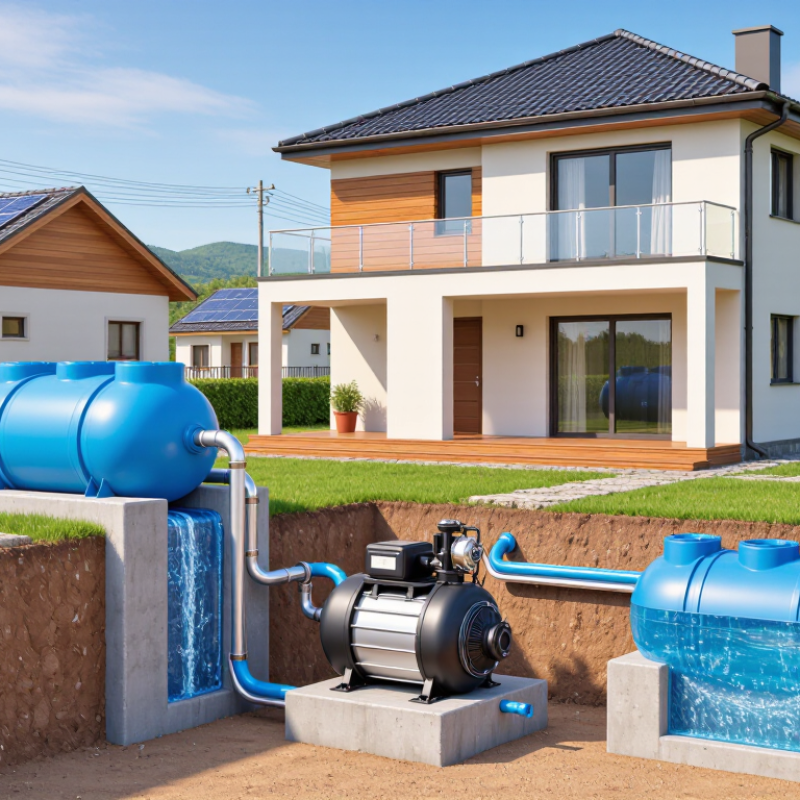
Closed-loop pumped hydro stores energy by moving water between two reservoirs at different heights. Unlike open-loop systems, it does not rely on a river or stream. A home-sized design might use a raised upper tank, a lower ground-level reservoir, a pump, and a reversible turbine. When electricity is available, the pump lifts water uphill. Later, flowing water drives the turbine and produces power.
The height difference matters. So does the water volume. A modest roof or garden slope may provide too little elevation for useful storage, while a large raised tank can place considerable weight on a building. That load needs professional structural assessment. The pump, pipes, valves, and turbine also need careful sizing; narrow pipes can waste energy through friction. Closed-loop systems can reduce water exchange with the surroundings, but they still need leak checks and occasional maintenance. Small details count.
The difficult question is whether the stored energy justifies the construction. Round-trip efficiency varies with system design, and small installations may lose a meaningful share of the electricity they store. Batteries are often simpler for ordinary homes. Still, pumped hydro may suit a property with a strong natural elevation change and space for both reservoirs. I would not assume a compact setup will be economical. The site measurements may say otherwise.
Top Types of Home Pumped Hydro Storage Systems: Closed-Loop Systems
Estimated water volume needed to deliver 10 kWh of electricity at different vertical heads. A closed-loop system cycles water between two reservoirs without relying on a natural waterway.
Illustrative estimates assume 85% turbine-generator efficiency and use gravitational potential energy to calculate the water volume. Actual requirements vary with equipment, hydraulic losses, and operating conditions; pumping energy and reservoir freeboard are not included.
Open-Loop Pumped Hydro Systems Using Natural Water Sources
Open-loop pumped hydro uses a natural water source, such as a stream or lake, as part of its storage system. Water is pumped uphill when surplus electricity is available, then released through a turbine when power is needed. The setup needs a meaningful height difference and dependable water access. A nearby stream alone is not enough.
At a home site, the practical details matter. A small intake, screened to limit debris, may feed a pipe running to an upper pond or reservoir. When water flows downhill, pipe length, bends, and diameter affect how much energy reaches the turbine. Seasonal water levels matter, too. That matters.
Open-loop systems can reduce the need to build two entirely separate water stores, but they interact directly with natural waterways. Sediment, aquatic habitats, downstream flow, and changing rainfall all deserve careful assessment. Local specialists can measure elevation, flow, and expected output before a design is chosen; permissions may also be required, depending on the location. The awkward part is that a promising site can still produce less energy than expected during dry months. Not always. Careful monitoring helps reveal those limits before equipment and excavation become major investments.
Tank-Based Pumped Hydro Systems for Compact Homes
Tank-based pumped hydro stores energy by moving water between two reservoirs at different heights. In a compact home, these may be sturdy tanks in a basement and on an upper floor, linked by pipes, a pump, and a small turbine. When electricity is available, the pump lifts water; later, water flows downhill to generate power. The layout is simple to picture. Safe installation is less simple.
The U.S. Department of Energy’s pumped-storage overview gives typical round-trip efficiency as roughly 70–80%. That figure describes pumped-storage systems generally, not a home tank installation; small equipment may perform differently. The height between tanks, pipe friction, pump choice, and turbine size all affect usable output. A one-storey home may offer too little elevation for worthwhile storage. Water is heavy, too: a 500-litre tank weighs about 500 kilograms before the tank itself. A structural assessment matters. This is often the part homeowners underestimate.
Tips:
Keep tanks on properly engineered supports, use leak detection and shut-off valves, and plan for overflow drainage. Measure the available height and estimate daily energy needs before buying equipment.
The honest drawback? Space and structural work can outweigh the energy benefit.
Gravity-Driven Modular Hydro Storage Systems
Gravity-driven modular hydro storage stores surplus electricity by pumping water into an elevated tank. When power is needed, water flows downward through a small turbine and returns to a lower reservoir. The system’s output depends on the height difference and the amount of water available. A compact module might use two sturdy tanks, pipes, valves, and a pump, but modest elevation can limit how much energy it stores. Small details matter. Pipe bends and narrow fittings can reduce flow, while a poorly supported tank can create serious structural risks.
Modular layouts allow components to be added gradually, which can suit a property with a suitable slope or a strong raised platform. The water circuit should be closed and protected from debris, leaks, freezing, and accidental access. Electrical controls also need appropriate isolation and professional assessment. The awkward part is scale: water is heavy, and useful storage may require more space than homeowners expect. A careful site survey should check load-bearing capacity, drainage, maintenance access, and local water conditions before installation. Even then, performance estimates are only estimates; real output changes with flow resistance and operating conditions. A simple test module can reveal these limits, though testing takes time and money.
Top Types of Home Pumped Hydro Storage Systems — Gravity-Driven Modular Hydro Storage Systems
| System Type |
Typical Configuration |
Usable Vertical Head |
Active Water Volume |
Estimated Stored Energy |
Key Planning Considerations |
| Elevated modular tank array |
Interconnected tanks on a purpose-built support structure, paired with a lower-level reservoir. |
5–12 m |
2–10 m³ |
About 0.02–0.23 kWh |
Compact and modular, but the support structure must be engineered for the substantial weight of stored water. |
| Freestanding tank tower |
A raised tank assembly connected by pipework to a ground-level tank or cistern. |
10–25 m |
10–40 m³ |
About 0.19–1.91 kWh |
Greater elevation increases energy per unit of water; tower foundations, wind loading, access, and local height rules require review. |
| Hillside upper-reservoir modules |
Modular upper tanks or a lined reservoir on a slope, with a lower reservoir at a lower elevation. |
15–60 m |
20–200 m³ |
About 0.57–22.91 kWh |
Can provide more storage where suitable terrain exists; site drainage, ground stability, water containment, and environmental approvals matter. |
| Elevated tank with buried lower cistern |
An above-ground modular upper tank paired with a buried or basement-level lower water store. |
8–20 m |
5–30 m³ |
About 0.08–1.15 kWh |
Uses a lower-level space efficiently, but excavation, waterproofing, tank access, and building loads need professional assessment. |
| Paired modular tank banks |
Several connected upper and lower tanks that can be arranged in parallel and isolated for maintenance. |
10–30 m |
20–100 m³ |
About 0.38–5.73 kWh |
Tank count can be adapted to the site; valves, pipe sizing, overflow routing, and balanced filling and emptying are important. |
|
Energy figures are approximate electrical energy delivered per discharge, calculated using E ≈ 0.002725 × head (m) × active water volume (m³) × 70% assumed round-trip efficiency. Actual results depend on pump and turbine performance, pipe friction, operating flow, and system design. These figures are illustrative planning ranges, not performance guarantees; structural, plumbing, electrical, and permitting requirements should be assessed for each site.
|
Comparing Residential Pumped Hydro System Designs
Residential pumped hydro systems differ mainly in their reservoirs and available height. A sloped property may support two small ponds, with water moving between them through a pipe. This design can store more energy when the vertical drop and usable water volume are substantial. Power depends on both. Yet excavation, lining, drainage, and erosion control can make the site work costly and visually intrusive.
A tank-based design uses an elevated upper tank and a lower cistern. It suits compact lots, but the structure must safely carry the tank’s full water load. That matters. A small height difference usually requires more water for comparable storage, while pumps, turbines, and pipes introduce energy losses. Closed-loop layouts also need checks for leaks, freezing, overflow, and access for maintenance. Not always obvious. A neat spreadsheet may miss those real-world details; even a careful estimate can change after measuring the actual elevation and usable space. The best comparison starts with those site measurements, then weighs storage needs against land, structural limits, and maintenance effort.